



Function
BIRKENSTOCK Buckley Shearling Suede Leather Black Walk Edit: First-Week Break-In, Strap Fit, and Hard-Floor Walking · BIRKENSTOCK Contour Walk
Why the Buckley Shearling Is a Different Kind of Walk
The BIRKENSTOCK Buckley Shearling Suede Leather is not a sneaker, not a slipper, and not a fashion clog that happens to have arch support. It sits in a useful middle ground: a backless, shearling-lined suede shoe built on the same cork footbed logic that has shaped BIRKENSTOCK walking for decades. If you are coming from foam slides or cushioned house shoes, the first week will feel like a conversation. The cork footbed talks back. The suede upper softens where you press. The shearling warms and compresses. This walk edit is about that first week—specifically, how the cork footbed breaks in, how to get the strap fit right, and what changes when most of your steps happen on hard floors.
The model here is the Buckley Shearling in Black suede leather, but the same notes apply across the color range: Taupe, Lavender Blush, Stone Coin, Dusty Teal, Olive Tree, Pink Clay, Maroon, and Dark Tea. Black is the most neutral starting point—it hides scuffs, reads clean with denim or wool, and lets the suede texture do the talking. The other colors shift the same shoe into different wardrobes: Taupe and Stone Coin for earth-tone layering, Lavender Blush and Pink Clay for softer palettes, Dusty Teal and Olive Tree for outdoor-adjacent outfits, Maroon and Dark Tea for deeper autumn and winter tones.
The Cork Footbed: What Break-In Actually Means
BIRKENSTOCK cork footbeds are not pre-molded to your foot. They are designed to mold. The cork and latex core is flexible but firm, and the top layer—suede or leather—starts relatively flat. During the first week, your body heat and weight gradually compress the cork in the places you load most: the heel cup, the metatarsal area, and the toe bar. That is the break-in. It is not about stretching the shoe out; it is about the footbed learning your pressure map.
Day one often feels surprising. The arch feels higher than you expect. The toe bar sits under the ball of your foot and makes you aware of muscles you normally ignore. The heel cup feels deep and slightly rigid. This is normal. The Buckley Shearling adds a shearling lining, which changes the first-week experience: the lining is soft and warm, so the upper feels immediately comfortable even while the cork is still firm. Do not mistake that upper softness for a fully broken-in footbed. The cork still needs time.

Days two through four are usually the turning point. If you are walking on hard floors—wood, tile, concrete, or thin carpet over slab—you will notice the footbed start to yield under the heel and forefoot. The arch begins to feel less like a bump and more like a shelf. The toe bar stops being a distraction and starts being a pivot point. By day five, many walkers report that the footbed feels "theirs" in a way that foam never does. By day seven, the cork has taken a visible set, and the shearling has compressed slightly in the heel and ball, which is exactly what you want.
Strap Fit: The Difference Between Snug and Tight
The Buckley Shearling has an adjustable strap across the instep. That strap is not decorative. It controls how your foot sits in the footbed, and it determines whether the cork breaks in evenly or in a lopsided pattern. The common mistake is over-tightening on day one. A strap that feels snug when you stand still can become uncomfortable after ten minutes of walking, because your foot spreads and the shearling compresses.
Start with the strap set so you can slide one finger under it with slight resistance. Walk around the room. If your heel lifts more than a centimeter, tighten by one hole. If the top of your foot feels pinched or your toes go numb, loosen by one hole. The goal is a fit where the footbed stays under your arch without clamping the instep. Because the Buckley is backless, your toes should not grip to keep the shoe on. If you feel toe clawing, the strap is too loose or the size is too large.
Width matters here. BIRKENSTOCK offers narrow and regular fits in many styles, and the Buckley Shearling follows that logic. If you have a high instep or a wide forefoot, the regular width gives the cork room to spread without pressing the suede upper. If you have a narrow foot, the narrow width keeps the footbed centered so the arch and toe bar land in the right places. A foot that slides side to side will break in the cork unevenly, which is why width is not a detail—it is part of the break-in.
Walking on Hard Floors: What Changes
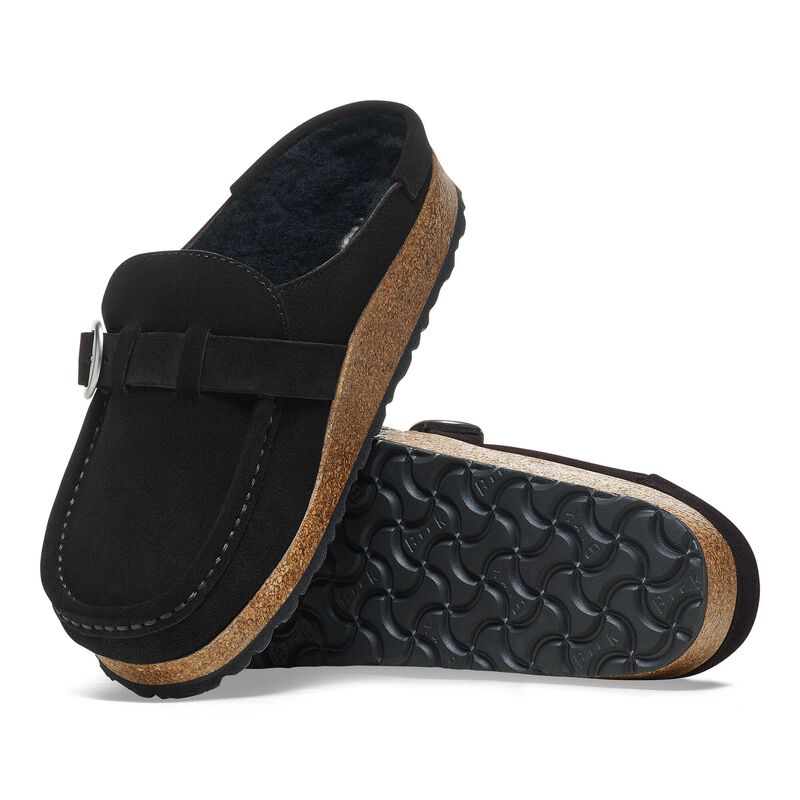
Hard floors are unforgiving. They send impact straight up through the shoe, and they expose every weakness in fit. This is why the first week on tile or concrete feels so different from walking on carpet. The cork footbed is your suspension. It does not bounce like foam; it distributes. When the cork is still new, that distribution is minimal, so your heels and knees feel more of the floor. As the cork compresses and conforms, the footbed starts to absorb and redirect pressure, and the same hard floor feels less aggressive.
For the first three days, keep hard-floor sessions short—twenty to thirty minutes at a time. Wear the Buckley Shearling around the house, then switch to another shoe if you need to stand for hours. By day four, you can extend to an hour. By day seven, many walkers can wear them for a full errand loop on pavement and tile without thinking about their feet. The shearling helps here because it reduces friction, which means fewer hotspots while the cork is still firm.
If you walk on hard floors all day, consider rotating the Buckley Shearling with a laced BIRKENSTOCK style for the first week. The cork footbed needs recovery time between wears, just like any molding material. A day of rest lets the cork cool and set, which actually speeds up the break-in. This is not a flaw; it is how cork works.
How the Buckley Compares to Arizona, Boston, and Madrid
The Arizona is the two-strap classic. It offers more forefoot adjustment, which can be helpful if your feet swell during the day. The Boston is a closed-toe clog with a roomier toe box, often chosen for cooler weather and workshop floors. The Madrid is a single-strap slide with a cleaner, more minimal profile. The Buckley Shearling sits between the Boston and the Madrid: it has the backless ease of a slide, the suede upper softness of a clog, and the added warmth of shearling. For first-week break-in, the Buckley is often easier than the Boston because there is no closed toe pressing on the front of your foot, and easier than the Madrid because the instep strap gives you more fit control than a single wide band.
If you already own an Arizona or Boston, you know the cork footbed rhythm. The Buckley Shearling follows the same curve, but the shearling lining adds a layer of immediate comfort that can make you forget the cork is still new. Pay attention anyway. The footbed is the engine; the shearling is the upholstery.
Material Notes: Suede Leather and Birko-Flor
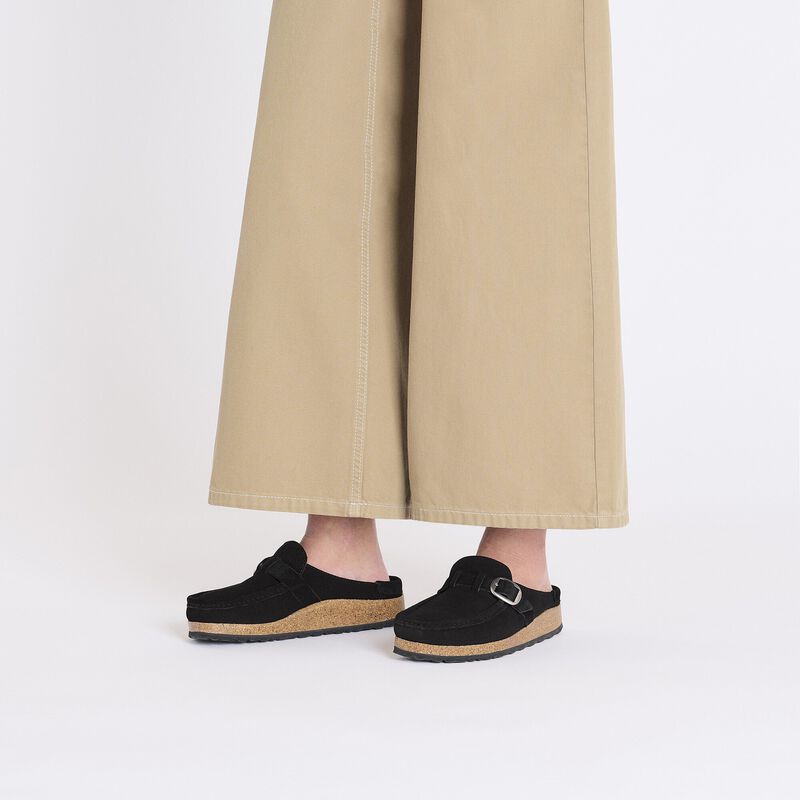
The Buckley Shearling uses suede leather for the upper. Suede is soft, breathable, and forgiving. It will stretch slightly where you flex and may show a faint crease across the instep after a week. That crease is normal and is a sign the shoe is fitting you, not breaking down. Keep suede away from heavy rain; if it gets damp, let it air-dry away from direct heat. A suede brush restores the nap and removes light dust.
Some BIRKENSTOCK styles use Birko-Flor, a durable synthetic upper that is easy to wipe clean and holds color well. The Buckley Shearling is not Birko-Flor—it is suede leather—but knowing the difference helps when you are comparing models. Birko-Flor is lower maintenance; suede leather is softer and molds more readily. For a first-week break-in on hard floors, suede leather tends to feel more forgiving against the skin, especially around the instep strap.
Color as a Walking Choice
Black is the default for a reason: it works with everything and hides the inevitable marks of daily walking. Taupe and Stone Coin are the quiet neutrals—easy with chinos, denim, and wool. Lavender Blush and Pink Clay soften the silhouette and pair well with lighter fabrics. Dusty Teal and Olive Tree lean outdoor; they look right with canvas, corduroy, and trail-adjacent layers. Maroon and Dark Tea are deeper, richer tones that suit autumn and winter and show less contrast against dark socks. None of these colors change the fit or the break-in. They change the mood. Choose the one that makes you want to put the shoe on, because the first week only works if you actually wear it.
A Simple First-Week Plan
Day 1: Wear indoors for 20 minutes. Set the strap with one finger of slack. Notice the arch and toe bar without judging them. Day 2: Wear for 30 minutes on hard floors. Adjust the strap after 10 minutes if needed. Day 3: Wear for 45 minutes. You should feel the heel cup starting to soften. Day 4: Wear for an hour, including a short outdoor walk. Day 5: Wear for two hours. The cork should feel less like a foreign object and more like a platform. Day 6: Wear for a half day. Check for even wear under the heel and ball. Day 7: Wear for a full day if comfortable. The footbed is now yours.
If you feel sharp pain, stop. Break-in soreness is dull and muscular; sharp pain is a fit problem. Recheck your width, your strap tension, and your size. The Buckley Shearling should feel secure but not tight, supported but not rigid. When the cork footbed, the suede upper, and the shearling lining all settle together, you get a walk that is quiet, warm, and surprisingly stable on hard floors. That is the point of the Buckley Shearling—not to be the softest shoe out of the box, but to become the most familiar one by the end of the first week.
View this BIRKENSTOCK style in the shop
People also search
BIRKENSTOCK Arizona oiled leather darkens over time
best color for BIRKENSTOCK Buckley Shearling Suede Leather Black Walk Edit everyday wear
BIRKENSTOCK Arizona vs Milano for ankle support
are BIRKENSTOCK cork footbed sandals good for all-day walking
BIRKENSTOCK Arizona taupe vs stone vs black which to buy
is BIRKENSTOCK Buckley Shearling Suede Leather Black Walk Edit true to size
BIRKENSTOCK Arizona vs Boston which is better for walking
best BIRKENSTOCK clog for indoor and outdoor
BIRKENSTOCK Arizona midnight vs black oiled leather
BIRKENSTOCK sizing guide regular vs wide width
BIRKENSTOCK sandals waterproof options EVA
BIRKENSTOCK Arizona two strap too loose how to tighten
BIRKENSTOCK sandals for nurses and long shifts
BIRKENSTOCK sandals for plantar comfort walking
BIRKENSTOCK Arizona white Birko-Flor scuff care
BIRKENSTOCK Buckley Shearling Suede Leather Black Walk Edit sizing and width fit
BIRKENSTOCK Arizona for wide feet reddit fit
BIRKENSTOCK Madrid vs Arizona for travel days
BIRKENSTOCK Boston break in time first week
BIRKENSTOCK suede vs nubuck which scuffs less
BIRKENSTOCK oiled leather clog care rain and commute
BIRKENSTOCK Arizona last chance colors worth buying
best BIRKENSTOCK sandals for standing all day at work
BIRKENSTOCK Mayari toe loop vs Gizeh fit
are BIRKENSTOCK sandals good for cobblestone city streets
BIRKENSTOCK Arizona white vs black everyday wear
BIRKENSTOCK Arizona outfit with linen summer clothes
BIRKENSTOCK Birko-Flor vs leather which lasts longer
BIRKENSTOCK men women unisex sizing how to choose
BIRKENSTOCK sandals lightweight hiking light trails
Trending BIRKENSTOCK searches
BIRKENSTOCK cork footbed
regular vs wide BIRKENSTOCK
BIRKENSTOCK wide width
BIRKENSTOCK Birko-Flor
BIRKENSTOCK for work standing
BIRKENSTOCK Gizeh
BIRKENSTOCK taupe suede
Buckley Shearling Suede Leather Black Walk Edit cork footbed
thong sandal Gizeh
Buckley Shearling Suede Leather Black Walk Edit oiled leather
BIRKENSTOCK stone Arizona
BIRKENSTOCK EVA sandals
BIRKENSTOCK unisex sizing
BIRKENSTOCK platform Arizona
BIRKENSTOCK oiled leather
summer BIRKENSTOCK outfits
BIRKENSTOCK tobacco leather
BIRKENSTOCK airport shoes
BIRKENSTOCK Arizona
BIRKENSTOCK Boston clog