



Function
London Wire Buckle Natural Leather Vintage Wood Roast Walk Edit: First-Week Cork Break-In, Strap Fit, and Hard-Floor Walking | BIRKENSTOCK Contour Walk
Why the London Wire Buckle Belongs in a Walking Rotation
The BIRKENSTOCK London Wire Buckle Natural Leather in Vintage Wood Roast and Vintage Wood Black is not a sneaker, and that is precisely the point. With its natural leather upper and signature cork footbed, this closed-toe clog gives you a leather-covered footbed that starts firm and then molds to your step. For walking on hard floors — tile, concrete, wood — the cork footbed is the part that matters most. It absorbs impact in a way that thin foam never can, and it does so without feeling mushy. The wire buckle is the adjustment point that keeps the upper connected to your foot, so the footbed can do its job instead of sliding around under you.
This Walk Edit focuses on the first week: what changes, what does not, and how to adjust the strap so the break-in works with your foot instead of against it. If you are considering the London in Vintage Wood Roast or Vintage Wood Black, treat this as a practical first-week map.
First-Week Cork Footbed Break-In: What Actually Happens
The cork footbed in the London is not flat. It has a raised arch, a heel cup, and a toe bar. In the first few days, those contours feel pronounced. That is normal. The cork and latex underneath the leather lining are firm at the start. As you walk, your body heat and weight gradually soften the cork, and the footbed begins to take on the shape of your foot. This is not a gimmick; it is the reason BIRKENSTOCK footbeds are trusted by people who stand and walk on hard surfaces all day.
Day one: wear them for 30 to 60 minutes indoors. You will notice the arch pressing up. You may notice the heel cup wrapping around the back of your heel. That pressure is the footbed asking your foot to settle. Day two and three: extend to a couple of hours, ideally on hard floors at home. The cork will start to give slightly under the heel and ball of the foot. By day four or five, the footbed should feel less like a foreign object and more like a base. By day seven, many walkers find the arch feels supportive rather than intrusive — a sign the cork has started to adapt.
Do not rush this. The London is a natural leather clog, not a broken-in shoe from a thrift rack. If you wear them for a full day on day one, you may end up with hot spots along the arch or heel. Instead, alternate with another pair for the first week. The cork needs rest between wears to cool and set. Think of it as training the footbed.
Strap Fit and the Wire Buckle: Small Adjustments, Big Difference
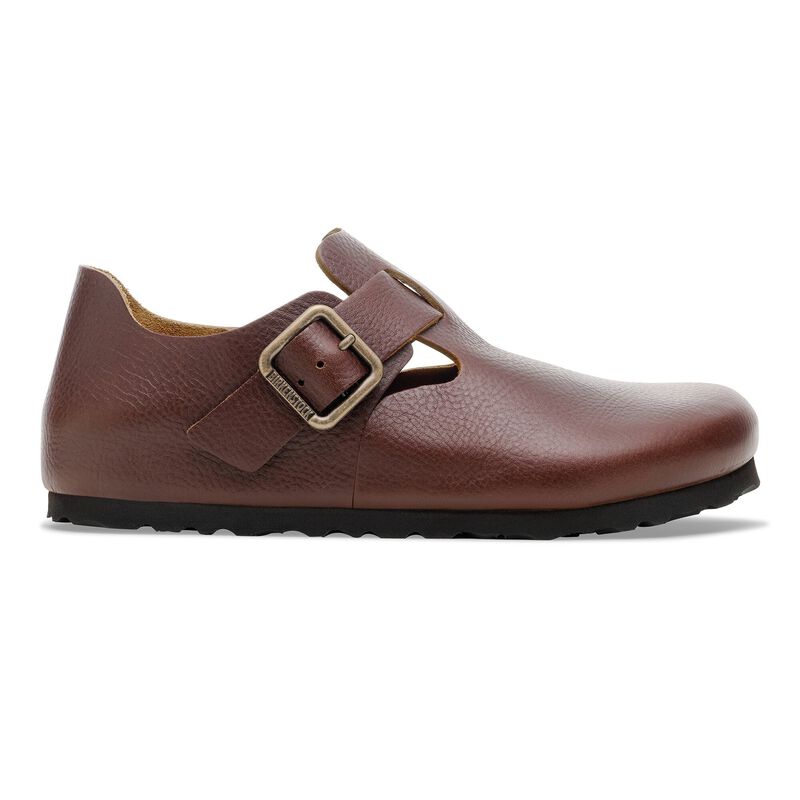
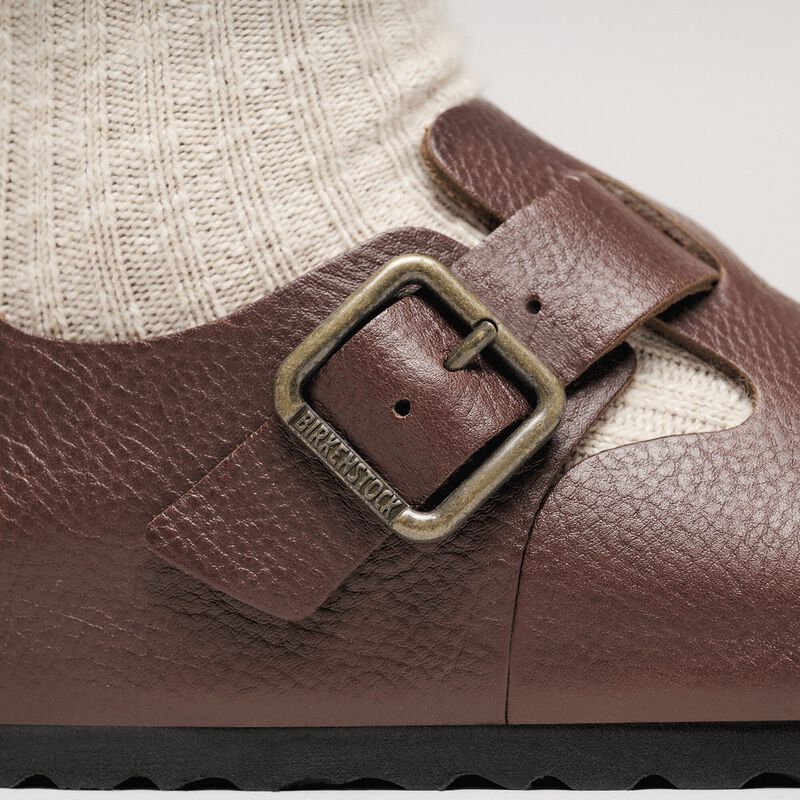
The London Wire Buckle uses a single metal wire buckle to adjust the strap across the instep. That strap is not decorative. It holds your foot against the footbed so your heel stays in the heel cup and your toes can grip the toe bar. If the strap is too loose, your foot slides forward on hard floors, and you will feel the arch in the wrong place. If it is too tight, the leather will press into the top of your foot, and the cork footbed cannot do its job because your foot is locked in one position.
Start with the buckle in the middle hole. Walk ten steps on a hard floor. Your heel should lift slightly with each step but not slide out. The strap should feel snug across the instep, not painful. If your foot moves forward and your toes touch the front, tighten one notch. If you feel pressure on the top of your foot, loosen one notch. Natural leather will stretch a little over the first week, especially across the instep, so it is better to start slightly snug than overly loose. Recheck the buckle after the first two days; many people need one adjustment once the leather warms up.
Vintage Wood Roast and Vintage Wood Black are both natural leather finishes with a slightly matte, vintage look. The leather is supple but not soft like a knit. It will crease across the vamp as you walk, which is normal and part of how the London molds. The wire buckle itself is metal and does not stretch, so the leather is the part that gives. Keep the buckle flat against the strap, not twisted, to avoid uneven pressure.
Walking on Hard Floors: Tile, Concrete, and Wood
Hard floors are where the London proves itself. On carpet, almost any shoe feels fine. On tile or concrete, you feel every step. The cork footbed in the London distributes pressure across the whole foot instead of concentrating it under the heel or ball. That is why people who work in kitchens, clinics, workshops, and retail often choose BIRKENSTOCK. The footbed is firm enough to support, but the cork and latex layer underneath gives just enough to take the edge off.
For the first week on hard floors, keep your distances short. Walk around the house, stand while cooking, take the dog out. On day three or four, try a 20-minute walk on pavement. Pavement is harder than indoor tile because it does not flex at all. You may feel the heel cup more on concrete. That is the cork still adapting. By the end of the week, the same walk should feel more even. If you feel sharp pain rather than pressure, stop and check your strap fit. The footbed should support, not bruise.
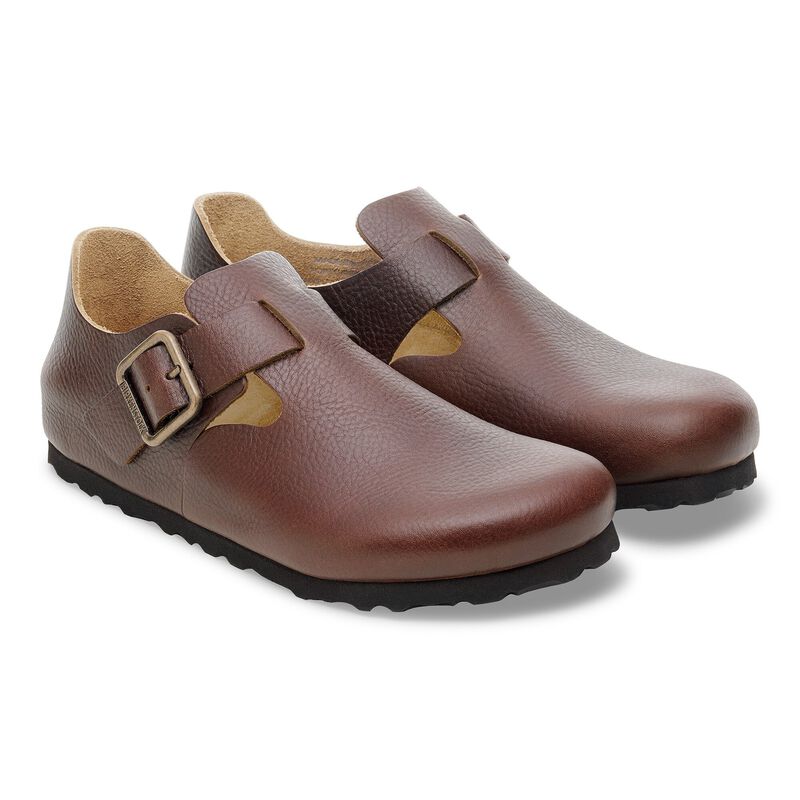
The London has a closed toe, so it is warmer than an Arizona or Madrid sandal. On hard floors indoors, that closed toe can make your feet warm, especially in Vintage Wood Roast, which is a darker, richer tone. If you run hot, consider thinner socks or no socks at home. The natural leather lining of the footbed will feel smooth against bare feet, and the cork will mold to your bare foot shape more directly.
How the London Compares to Other BIRKENSTOCK Styles
If you already know the Arizona two-strap sandal, the London will feel familiar underfoot. The cork footbed is the same philosophy: raised arch, deep heel cup, toe bar. The difference is the closed upper and the wire buckle. The Arizona lets your foot move freely; the London holds it in place. For hard-floor walking, that extra hold can be helpful because your foot does not slide sideways. The Boston clog is another closed style, but the London has a more structured strap and buckle, which gives a more secure fit across the instep.
The Madrid is a single-strap sandal, minimal and open. It is great for warm weather, but on hard floors, the London gives more coverage and a more stable platform. The Birko-Flor versions of BIRKENSTOCK styles are easy to clean and vegan-friendly, but this London is natural leather, so it will develop a patina. Vintage Wood Black will show creases and scuffs as lighter marks; Vintage Wood Roast will darken slightly in areas of flex. That is normal for natural leather and part of the vintage character.
Width, Sizing, and the First-Week Fit Check
BIRKENSTOCK offers its footbeds in multiple widths. The London follows that system. If you have a wider forefoot, the regular width gives more room across the toes. If you have a narrower foot, the narrow width keeps your foot from sliding. Getting the width right matters more in a closed style like the London because the leather upper does not stretch as much as a sandal strap. A good test: stand in the London and wiggle your toes. They should have room to move without touching the front. Your heel should sit inside the heel cup, not on top of it.
During the first week, your foot may shift slightly as the cork compresses. Recheck the buckle and the heel position after a few days. If your heel starts to slip, tighten the strap one notch. If your toes feel cramped, loosen one notch. The natural leather will soften, but it will not grow. Sizing is the one thing break-in cannot fix. If the length is wrong, exchange before you put miles on them.
Caring for the Cork and Leather During Break-In
Keep the cork footbed dry. If you walk on hard floors in a humid climate or after rain, let the London air out away from direct heat. Do not put them in a dryer or on a radiator; heat can crack the cork. The natural leather upper can be wiped with a damp cloth and, if needed, treated with a leather conditioner after the first month. During the first week, less is more. Let the footbed adapt to your foot without extra sprays or inserts.
If the wire buckle feels loose, check that the wire is seated properly in the strap holes. The metal is sturdy, but a twisted strap can make the buckle feel uneven. Smooth the leather flat before buckling. The Vintage Wood Roast and Vintage Wood Black finishes are both relatively low-maintenance. A soft brush can remove dust from the cork edge, and a damp cloth can refresh the leather.
When to Wear the London for Travel and Everyday Walks
The London is a travel-friendly clog because it slips on and off easily at security or in a hotel room, and the cork footbed handles airport tile and city pavement. For a first-week break-in, travel might be too much. But once the footbed has started to mold — usually after seven to ten days of short wears — the London becomes a reliable walking shoe for errands, commuting, and light travel. It is not a hiking boot, and it is not a running shoe. It is a supportive leather clog for hard surfaces and long stands.
If you are packing for a trip, wear the London on the plane or train for a few hours, then switch to another pair for the rest of the day. This keeps the break-in gradual. On hard hotel floors, the cork footbed will feel welcome after a day of sightseeing. The wire buckle stays put, so you are not constantly adjusting. That is the quiet advantage of the London: once the strap is set, you forget about it and walk.
Final First-Week Checklist for the London Wire Buckle
Start with 30 to 60 minutes on day one. Adjust the wire buckle to a snug-but-not-tight fit across the instep. Walk on hard floors at home before you take them outside. Expect the arch and heel cup to feel strong at first; that is the cork footbed doing its job. Recheck the buckle after two days. Keep the cork dry. By day seven, the London should feel less like a new shoe and more like a base for your foot. The Vintage Wood Roast and Vintage Wood Black colorways will both show honest wear, which is part of the point. This is a BIRKENSTOCK clog made for walking, not for standing still in a box.
View this BIRKENSTOCK style in the shop
People also search
how to stretch tight BIRKENSTOCK sandals at home
how to clean BIRKENSTOCK Birko-Flor without damage
BIRKENSTOCK Arizona vs Super-Birki garden clog
best BIRKENSTOCK for weekend travel packing
how to store BIRKENSTOCK cork footbed between seasons
BIRKENSTOCK Arizona white Birko-Flor scuff care
BIRKENSTOCK footbed packed out when to replace
BIRKENSTOCK footbed sandals break-in no blisters
best BIRKENSTOCK for city walking tour
BIRKENSTOCK kids vs adult sizing for small feet
BIRKENSTOCK Boston clog with socks in cold weather
BIRKENSTOCK wide width sandals for high volume feet
BIRKENSTOCK sizing EU to US conversion chart
BIRKENSTOCK Arizona mocha vs dark brown
BIRKENSTOCK men women unisex sizing how to choose
BIRKENSTOCK cork latex footbed how long it lasts
BIRKENSTOCK Gizeh regular vs platform
BIRKENSTOCK Arizona vs Boston which is better for walking
BIRKENSTOCK Madrid vs Arizona for travel days
best color BIRKENSTOCK Arizona for everyday
BIRKENSTOCK footbed sandals for standing on hard floors
BIRKENSTOCK Kyoto vs Boston clog comparison
BIRKENSTOCK Arizona vegan Birko-Flor vs leather
BIRKENSTOCK Arizona metallic vs classic leather
BIRKENSTOCK sizing guide regular vs wide width
best BIRKENSTOCK sandals for standing all day at work
BIRKENSTOCK Arizona mink vs tobacco oiled leather
BIRKENSTOCK Boston fit compared to Arizona
BIRKENSTOCK suede vs nubuck which scuffs less
do BIRKENSTOCK sandals work without socks
Trending BIRKENSTOCK searches
BIRKENSTOCK Arizona
BIRKENSTOCK cork footbed
BIRKENSTOCK Madrid sandal
BIRKENSTOCK sizing
Arizona vs Boston
BIRKENSTOCK Birko-Flor
thong sandal Gizeh
Boston vs Kyoto
summer BIRKENSTOCK outfits
BIRKENSTOCK 2026 trends
BIRKENSTOCK Big Buckle
BIRKENSTOCK travel sandals
BIRKENSTOCK unisex sizing
two strap sandal
BIRKENSTOCK oiled leather
BIRKENSTOCK city walking
London Wire Buckle Natural Leather Vintage Wood Roast Walk Edit cork footbed
BIRKENSTOCK new colors
BIRKENSTOCK beach EVA
all day walking sandals